
Synergetic Lattice Field Theory
CONTENTS
SYNERGETIC GEOMETRY
Buckminster Fuller
Buckminster Fuller was a 20th century inventor, architect, philosopher and poet. In his own words, he was a “comprehensivist” and a “generalist”. He developed synergetic geometry [1, 2] in order to identify and elucidate “the family of generalized principles” governing the Universe. He is probably most famous for the invention of the geodesic dome. He conceived of the geodesic dome as a special case invention derived from the pure principles embodied in synergetic geometry.
Synergetics Core Principles
Some of the core principles governing synergetic geometry include the concepts of triangulation, closest-packing of spheres (as a generalized conceptual representation of localized "energy events"), and last but not least, the tetrahedron. The tetrahedron and its various self-symmetric relationships are foundational elements of synergetic geometry.

Figure 1: Tetrahedron. The tetrahedron is the simplest regular polyhedron. It is constructed solely from equilateral triangles and has four faces, four vertices, and six edges.
Underscoring the essential importance of the tetrahedron in synergetic geometry, one entire section of Fuller's first book on synergetic geometry ("Synergetics" [1]) is titled "Tetrahedron Discovers Itself and Universe" [3]. Fuller referred to the tetrahedron as "omni-triangulated" because it is composed solely of equilateral triangles. The other two "omni-triangulated", regular polyhedrons, the octahedron and icosahedron, also play important roles in synergetic geometry.

Figure 2: Omni-Triangulated Polyhedra. The tetrahedron (prior figure), and the octahedron (left) and icosahedron (right) are three of the five Platonic or regular polyhedra. These three polyhedra are the only “omni-triangulated” (constructed solely from equilateral triangles) polyhedra among the regular and semi-regular polyhedrons. By virtue of their “omni-triangulation”, these polyhedrons have inherent structural strength and stability when they are realized as “real world” structures.
From these core concepts, Fuller developed other key elements of synergetic geometry, including the “vector equilibrium”, the "isotropic vector matrix", and their "jitterbug" transformations. It is these elements of synergetic geometry, specifically, that synergetic lattice field theory (SLFT) has adopted as foundational elements, and as a starting point from which further natural extensions and modifications of synergetic geometry have been developed in order to support bridging the gap between synergetic geometry and modern physics.

Figure 3: Vector Equilibrium. Synergetic's vector equilibrium (left) illustrating its construction from eight tetrahedrons situated around a common central point. Each tetrahedron contributes three internal edges or vectors, and an additional three external edges, creating a total of 24 internal (radial), unit edge vectors, and 24 external (circumferential) unit edge vectors. The octahemioctahedron (right) provides an alternative realization of the vector equilibrium, with an emphasis on its 8 external faces and 24 internal faces. The external shells of both these figures are isomorphic to the cuboctahedron.

Figure 4: Isotropic Vector Matrix. The isotropic vector matrix (“IVM”) is defined by the three-dimensional honeycomb lattice created by a set of tetrahedrons and octahedrons stacked together to fill space. The left figure shows a small set of two layers of tetrahedrons stacked together. This stacking of tetrahedrons includes empty pyramid shaped regions between the tetrahedrons. The right figure shows a set of octahedrons nested into some of the empty pyramid shaped regions in the left figure. This combined stacking of tetrahedrons and octahedrons can be extended indefinitely to span arbitrarily large spatial extents.
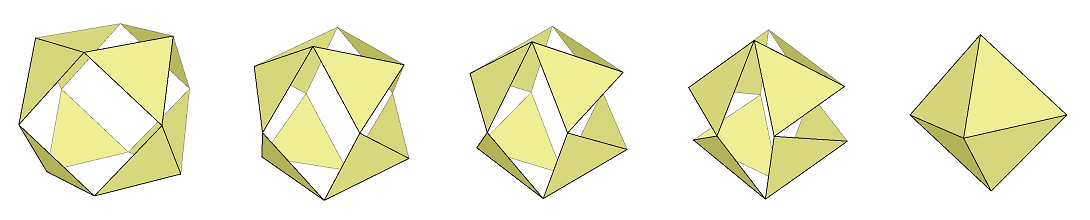
Figure 5: Jitterbug Transformation. The sequential "jitterbug" contraction of the vector equilibrium from its cuboctahedral phase (far left) to its octahedral phase (far right), passing through its icosahedral phase (second from left), SLFT's isomorphic phase (middle), as well as another asymmetrical icosahedral phase (fourth figure). (Animation.)
Synergetics and Modern Physics
Synergetic geometry can be seen as Fuller's own unique, geometric exploration of general systems theory. Being in essence a generalist, Fuller was not a specialist in any particular domain, including physics. He nevertheless felt that the generalized principles he elucidated, and especially their geometric realizations as embodied in his synergetic geometry, should, by definition, have direct applications in all fields, including physics.
To that end, Fuller overtly speculated that synergetic geometry could help explain some of the observed properties of elementary particles [4,5,6,7], and that it might even someday provide the foundation for a unified field theory [8]. Notwithstanding his speculations on these topics, he never provided a detailed schema that included a complete and comprehensive application of synergetic geometry to the core problems of modern physics. He did, however, encourage others to do so [4].
Synergetics Reference Materials
The definitive source materials for synergetic geometry are Fuller's "Synergetics" [1] and "Synergetics 2" [2]. Amy Edmondson's condensed summary and clear explanation of synergetics, "A Fuller Explanation" [9] is also a very good resource. Some may find Dr. Edmondson's book to be an especially accessible and comprehensible introduction to synergetic geometry.
[1] R. B. Fuller, Synergetics, Macmillan, New York, 1978.
[2] R. B. Fuller, Synergetics 2, Macmillan, New York, 1979.
[3] R. B. Fuller, Synergetics, Macmillan, New York, 1978, p. 209.
[4] R. B. Fuller, Synergetics2, Macmillan, New York, 1979, p. 415.
[5] R. B. Fuller, Synergetics, Macmillan, New York, 1978, p. 678.
[6] R. B. Fuller, Synergetics2, Macmillan, New York, 1979, p. 269.
[7] R. B. Fuller, Synergetics2, Macmillan, New York, 1979, p. 406.
[8] R. B. Fuller, Synergetics2, Macmillan, New York, 1979, pp. 238-239.
[9] A. C. Edmondson, A Fuller Explanation: The Synergetic Geometry of R. Buckminster Fuller, Birkhauser, Boston, 1987.