
Synergetic Lattice Field Theory
CONTENTS
A NEW MODEL OF THE UNIVERSE
BUCKMINSTER FULLER'S SYNERGETIC GEOMETRY APPLIED TO MODERN PHYSICS
Is it possible that Buckminster Fuller's "synergetic geometry" can be used to construct a unified field theory that explains some of the most important and enduring questions about our universe? What is dark matter? What is the basis of Einstein’s “spooky action at a distance” (quantum entanglement)? What are the actual structures of space and elementary particles? Can Einstein's dream of unifying elementary particles with space, as distortions of space itself, be realized? Can Fuller's vision of his "synergetic geometry" supporting a unified field model be realized?
Synergetic Lattice Field Theory (SLFT) attempts to answer these questions. The figures below provide an overview of the theory, "in a nutshell": the standard model's fermions are just local distortions of a universal lattice and gauge bosons are composite particles constructed from pairs of positive mass and negative mass fermions.
Click on any of the images or animations below in order to enlarge them.


Figure 1: The Synergetic Field. This Figure shows a tiny section of the synergetic field. This section shows a “10 X 10 X 10”, three-dimensional array of one thousand (1000) atomic units of the synergetic field. These Planck scale atomic units of the field are called "isomorphic vector equilibria". These isomorphic vector equilibria come in left-handed and right-handed versions. The illustration shows a tiny section of the synergetic field encompassing 1000 left-handed vector equilibria. For visual clarity, the second set of 1000 right-handed vector equilibria, which are situated in the interstitial spaces between the 1000 illustrated left-handed vector equilibria, are not shown.
Figure 2: "Jitterbug" Transformations of the Synergetic Field. This animation shows a very small array of isomorphic vector equilibria within the synergetic field that includes both left-handed (yellow) and right-handed (pink) instances. The animation shows them undergoing coordinated "jitterbug" transformations between their octahedral and cuboctahedral phases. It is these coordinated "jitterbug" transformations that form the foundation of the synergetic field’s ability to support localized deformations. SLFT identifies such localized deformations of the field with the standard model’s fermions (see Figures 3-8, below).
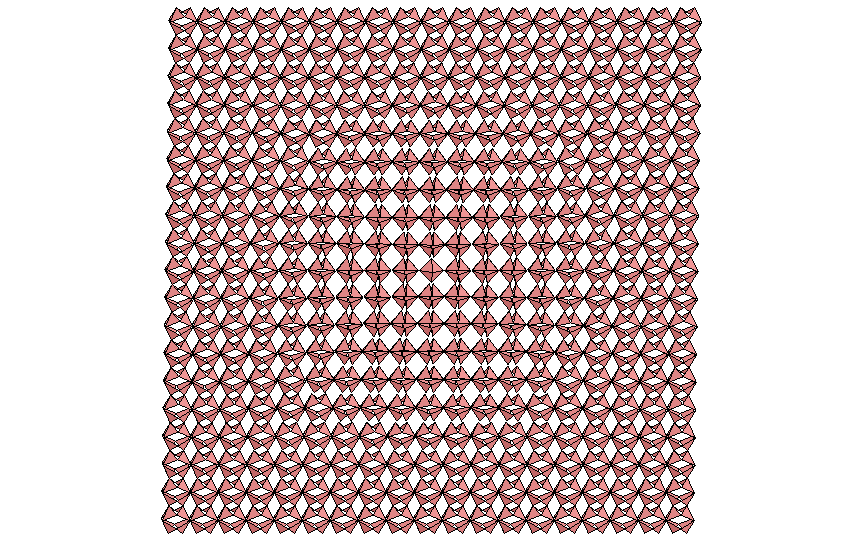
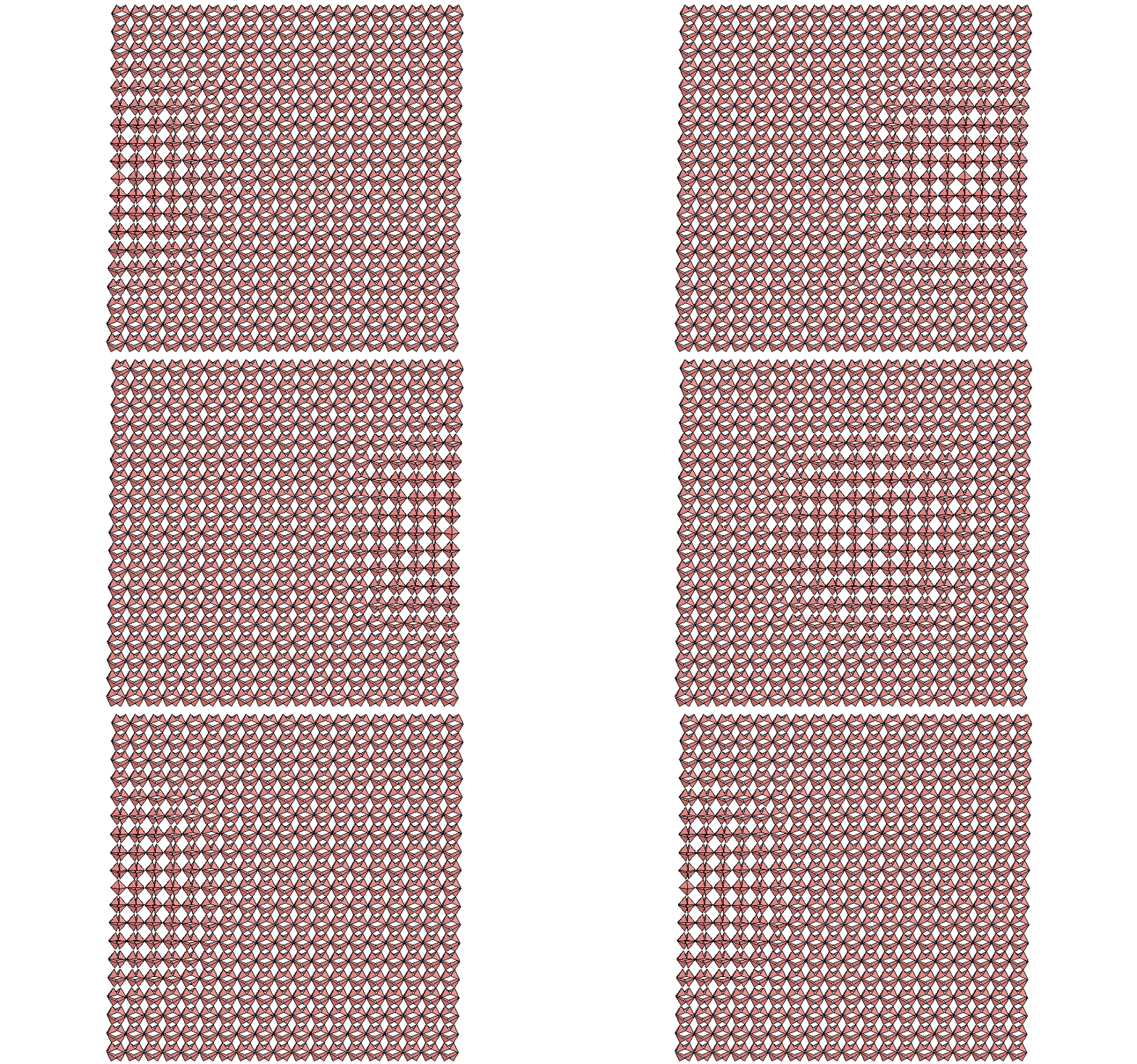
Figure 3: Electrons in the Synergetic Field. The localized deformation of the synergetic field associated with an electron. The centermost vector equilibrium in the figure is contracted to its octahedral phase. As one moves radially away from this centermost vector equilibrium the surrounding vector equilibria gradually morph into their isomorphic phases. This pattern of deformation spanning multiple vector equilibria defines an electron in the synergetic field. In this figure the area of deformation is just a handful of vector equilibria wide. In nature it is expected to span hundreds, or thousands, or more vector equilibria. An electron is nothing other than this local pattern of deformation. It is not a separate entity external to the field but is rather part and parcel of the synergetic field itself.
Figure 4: Electron Motion Through the Synergetic Field. This animation shows the motion of an electron through a local, two-dimensional cross-section through the synergetic field. In this animation, the center of motion of the electron is defined by the vector equilibrium that is fully contracted to its octahedral phase. The animation starts with this centermost, octahedrally contracted vector equilibrium on the left side of the screen. The collective octahedral contraction moves from left to right across the field of view and back again, repeatedly bouncing back and forth. When it pauses on either the right side or left side, the octahedral contraction is clearly visible compared to the vector equilibria further away that are in their isomorphic phases.
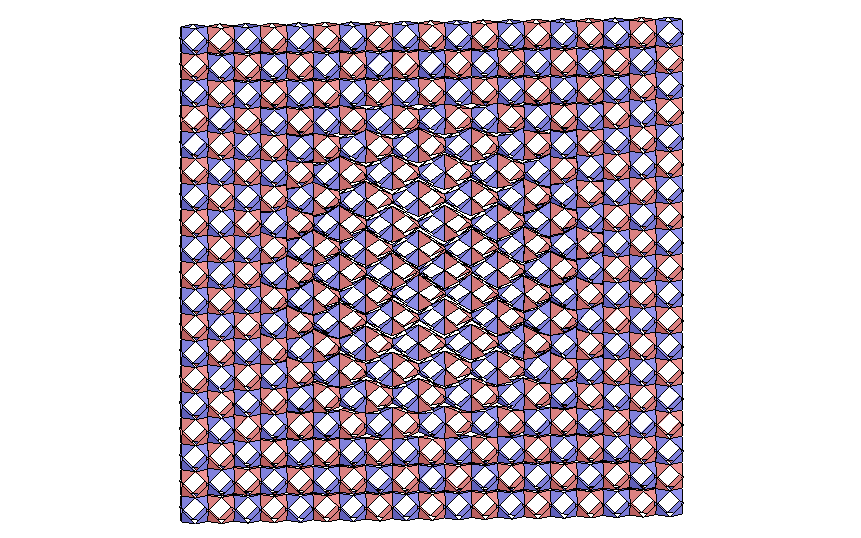
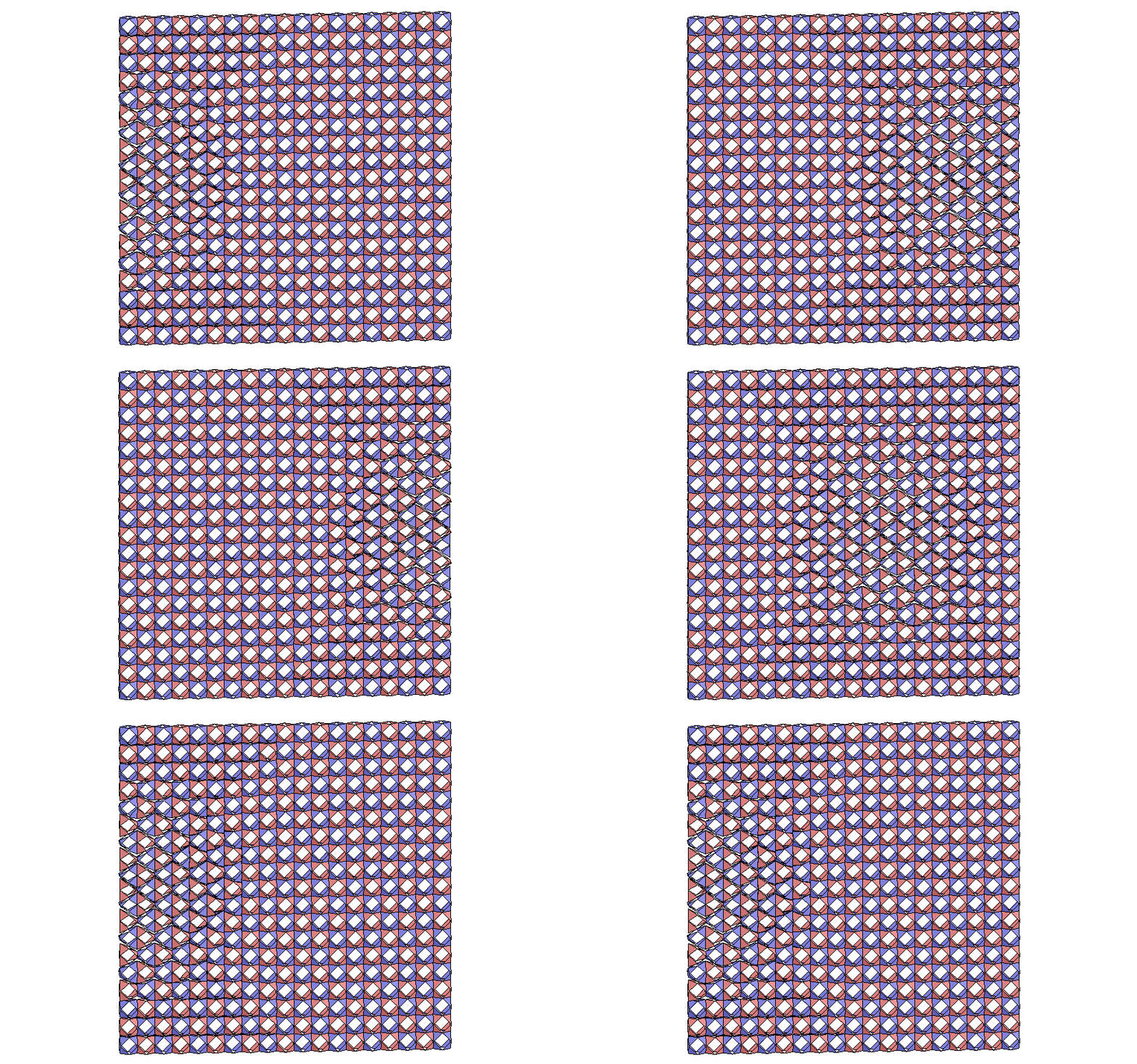
Figure 5: Quarks in the Synergetic Field. The localized deformation of the synergetic field associated with a quark. The centermost isomorphic vector equilibrium in the figure is contracted to its tetrahedral phase. As one moves radially away from this centermost vector equilibrium the surrounding vector equilibria gradually morph into their cuboctahedral phases. This pattern of deformation spanning multiple vector equilibria defines a quark in the synergetic field. The shown deformation is just a handful of vector equilibria wide. In nature it is expected to span hundreds, or thousands, or more vector equilibria. A quark is nothing other than this local pattern of deformation. It is not a separate entity external to the field but is rather part and parcel of the field itself.
Figure 6: Quark Motion Through the Synergetic Field. This figure shows the motion of a quark through a local, two-dimensional cross-section through the synergetic field. In this figure, the center of motion of the quark is defined by the vector equilibrium that is contracted to its tetrahedral phase. The animation starts with this centermost, tetrahedrally contracted vector equilibrium on the left side of the screen. The collective tetrahedral contraction moves from left to right across the field of view and back again, repeatedly bouncing back and forth. When it pauses on either the right side or left side, the tetrahedral contraction is clearly visible compared to the vector equilibria further away that are in their cuboctahedral phases.
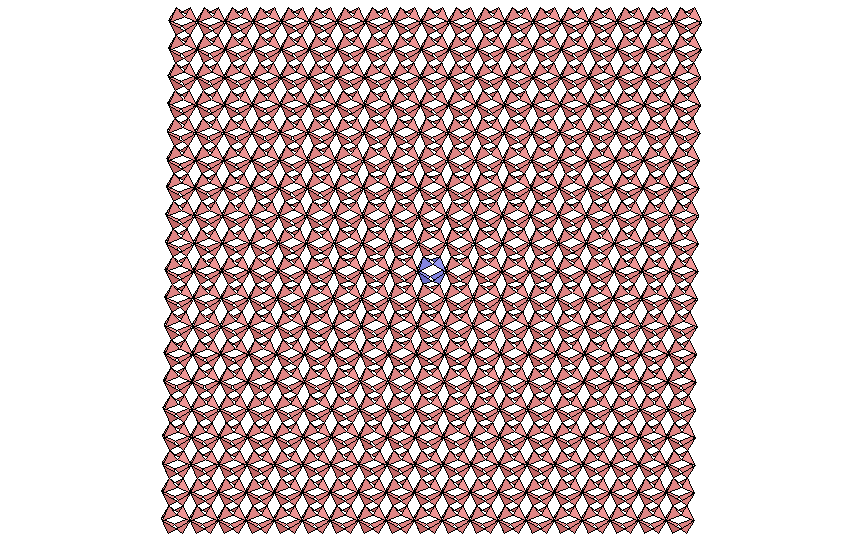
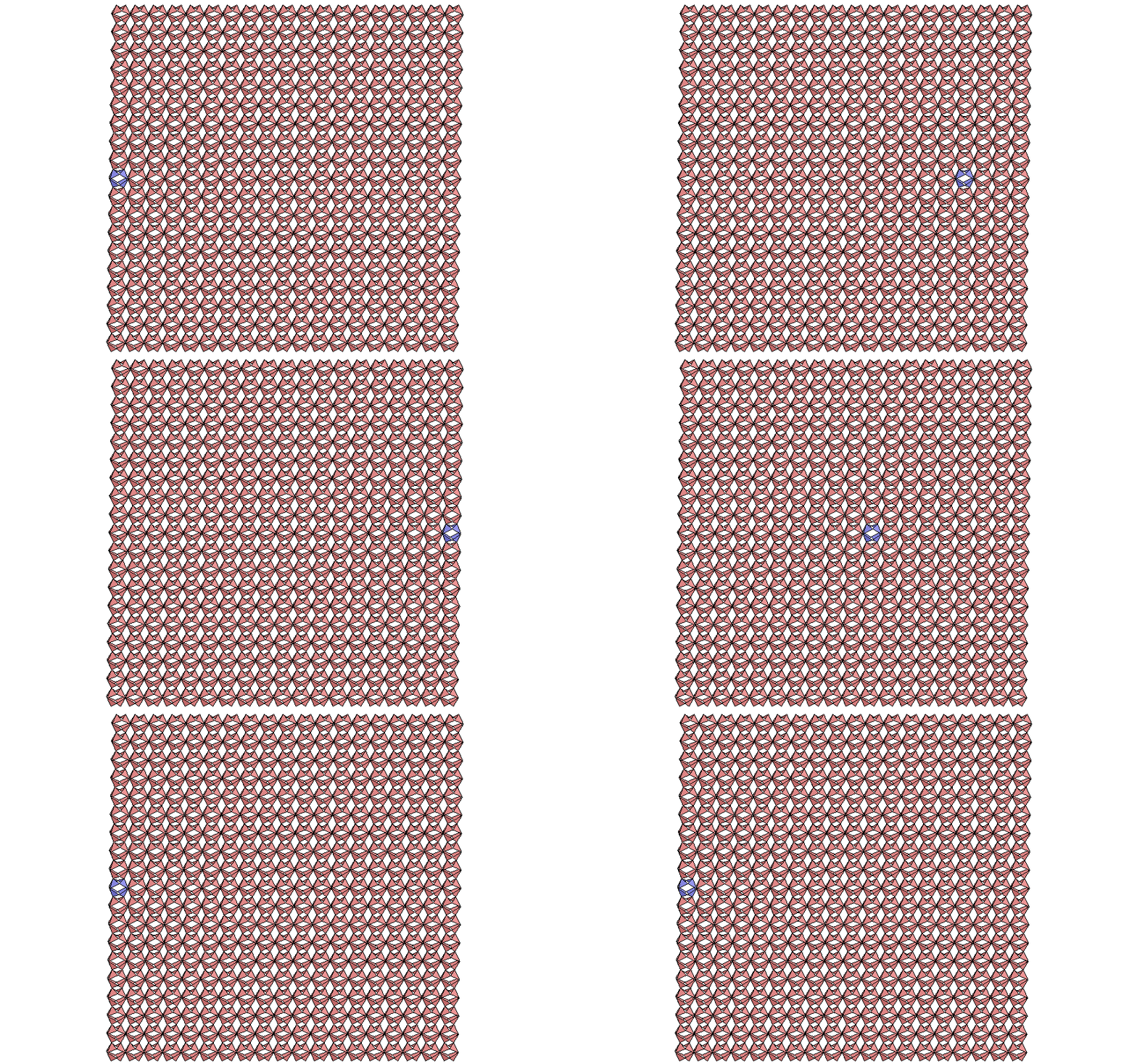
Figure 7: Neutrinos in the Synergetic Field. The localized deformation of the synergetic field associated with a neutrino. The centermost vector equilibrium in the figure is in its icosahedral phase (shaded blue). As one moves radially away from this centermost vector equilibrium the surrounding vector equilibria gradually morph into their isomorphic phases. This pattern of deformation spanning multiple vector equilibria defines a neutrino in the synergetic field. The shown deformation is just a handful of vector equilibria wide. In nature it is expected to span hundreds, or thousands, or more vector equilibria. A neutrino is nothing other than this local pattern of deformation. It is not a separate entity external to the field but is rather part and parcel of the synergetic field itself.
Figure 8: Neutrino Motion Through the Synergetic Field. This animation shows the motion of a neutrino through a local, two-dimensional cross-section through the synergetic field. In this animation, the center of motion of the neutrino is defined by the vector equilibrium that is in its icosahedral phase (shaded blue). The animation starts with this centermost, icosahedrally configured vector equilibrium on the left side of the screen. The collective icosahedral contraction moves from left to right across the field of view and back again, repeatedly bouncing back and forth. When it pauses on either the right side or left side, the icosahedral configuration is visible, with close inspection, compared to the vector equilibria further away that are in their isomorphic phases.