
Synergetic Lattice Field Theory
CONTENTS
SYNERGETIC LATTICE FIELD THEORY - CORE CONCEPTS
A New Model of Elementary Particles and Space
Synergetic lattice field theory (SLFT) presents a new model of elementary particles and space based on the application of Buckminster Fuller's synergetic geometry [1, 2], with some natural modifications and extensions, to problems in modern physics. More specifically, SLFT defines a Planck scale “atomic unit” of space as the foundation of the physical space of our universe. SLFT derives this atomic unit from synergetic geometry’s “vector equilibrium” [3] and calls it the “isomorphic vector equilibrium”.
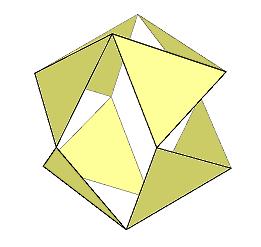
Figure 1: Isomorphic Vector Equilibrium. A single, left-handed, isomorphic vector equilibrium. The isomorphic vector equilibrium is a specific configuration of synergetic geometry’s vector equilibrium. The isomorphic vector equilibrium defines SLFT's atomic unit of space. Its external shell consists of eight equilateral triangles. It also has 24 internal faces that, for simplicity, are not shown in this diagram. (Note: The isomorphic vector equilibrium has a direct morphological relationship to Jessen's orthogonal icosahedron [4]. Although it is different from Jessen’s icosahedron, it shares the same set of exterior vertex coordinates. It is also noteworthy that the external shell of both the isomorphic vector equilibrium and Jessen’s icosahedron can be derived from a specialized truncation of the truncated octahedron.)
A Universal, Deformable Space Lattice
SLFT defines the entire space of the physical universe as a deformable lattice formed from stacking together innumerable copies of this atomic unit of space with itself. SLFT refers to this lattice as the “isomorphic isotropic vector matrix”, or simply the “synergetic field”.

Figure 2: The Synergetic Field. A small section of SLFT's isomorphic isotropic vector matrix, which defines the synergetic field. The figure shows a “5 X 5 X 5”, three-dimensional array of 125 isomorphic vector equilibriums. The full isomorphic isotropic vector matrix is constructed from equal numbers of interwoven “left-handed” and “right-handed” isomorphic vector equilibriums. For visual clarity this figure only shows 125 left-handed isomorphic vector equilibriums. An additional 125 right-handed isomorphic vector equilibriums can be woven into the interstitial spaces that exist between these 125 left-handed isomorphic vector equilibriums.
Elementary Particles as Local Deformations of the Field
The resulting matrix defines a discrete, universal, deformable lattice. SLFT identifies the local deformations of this lattice, which are limited in number and precisely defined in structure, with the standard model’s elementary particles (i.e. quarks, electrons, and neutrinos). An electron for example, is associated with a localized, octahedron-based deformation of the field.
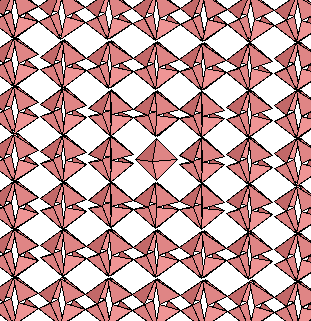
Figure 3: Electrons in the Synergetic Field. A two-dimensional cross-section through the synergetic field in the area of a localized octahedral contraction of the synergetic field’s left-handed vector equilibria. SLFT identifies such areas of local contraction with elementary particles. The center most vector equilibrium in the illustration is contracted to its octahedral configuration. SLFT identifies such localized, octahedral contractions with electrons. The vector equilibria surrounding the center most vector equilibrium are also contracted, but gradually expand from their octahedral configurations towards their isomorphic configurations. (For the sake of visual clarity, the rate of change in contraction between neighboring vector equilibria is greatly exaggerated in this illustration. Also, for visual clarity, the vector equilibria in the second set of interstitial, right-handed cuboctahedral phase vector equilibria are not shown.)
In an analogous fashion, quarks and neutrinos are respectively associated with localized, tetrahedron-based and icosahedron-based deformations of the field. Greater degrees of local contraction of the field are associated with relatively greater amounts of rest mass for the particles associated with these localized contractions.

Figure 4: Tetrahedral "Jitterbug" Transformation. SLFT associates the tetrahedral phase of the vector equilibrium with quarks. The illustration shows the sequential contraction of the vector equilibrium from its cuboctahedral phase (far left) to its tetrahedral phase (far right). During this contraction two oppositely oriented square openings in the vector equilibrium progressively pinch together in orthogonal directions until the tetrahedral phase is reached. In this instance the two square openings that pinch together are the left and right facing openings. The left opening pinches together parallel to the page’s vertical axis. The right opening pinches together parallel to an axis that runs in-and-out of the page. This tetrahedral contraction can be seamlessly embedded within the synergetic field in a manner analogous to the way in which the octahedral contraction associated with electrons is embedded in the field. (Animation.)
Elementary Particle Masses
The relative masses of the standard model's elementary fermions are ordered in increasing magnitude from neutrinos to electrons to quarks. Similarly, the localized contractions of the synergetic field that are respectively associated with these three fundamental fermions increase in relative magnitude from icosahedral contractions (associated with neutrinos) to octahedral contractions (associated with electrons) to tetrahedral contractions (associated with quarks).
Geometric Explanations of Particle Properties
Based on the above associations and the geometry of the synergetic field, itself, SLFT is able to provide geometrically based explanations for the standard model’s specific spectrum of elementary fermions and bosons, the fractional electric charges carried by quarks, quark flavors, the color charges carried by quarks, some of the unique properties of neutrinos, as well as geometric motivations for the existence of precisely three generations of elementary particles.
SLFT further proposes that the isomorphic isotropic vector matrix lattice, itself, with or without local deformations, is the ground from which both the “vacuum state” of quantum field theory and the spacetime of relativity simultaneously arise, as emergent theoretical frameworks.
A paper providing a complete and detailed description of the theory, including many additional illustrations, can be downloaded here. Supporting animations of various geometric transformations central to the theory are available here.
[1] R. B. Fuller, Synergetics, Macmillan, New York, 1978.
[2] R. B. Fuller, Synergetics 2, Macmillan, New York, 1979.
[3] R. B. Fuller, Synergetics, Macmillan, New York, 1978, pp. 151-182.
[4] B. Jessen, Orthogonal Icosahedra, Nordisk Matematisk Tidskrift, 15 (2) (1967) 90–96.